Emilia-Romagna
Description
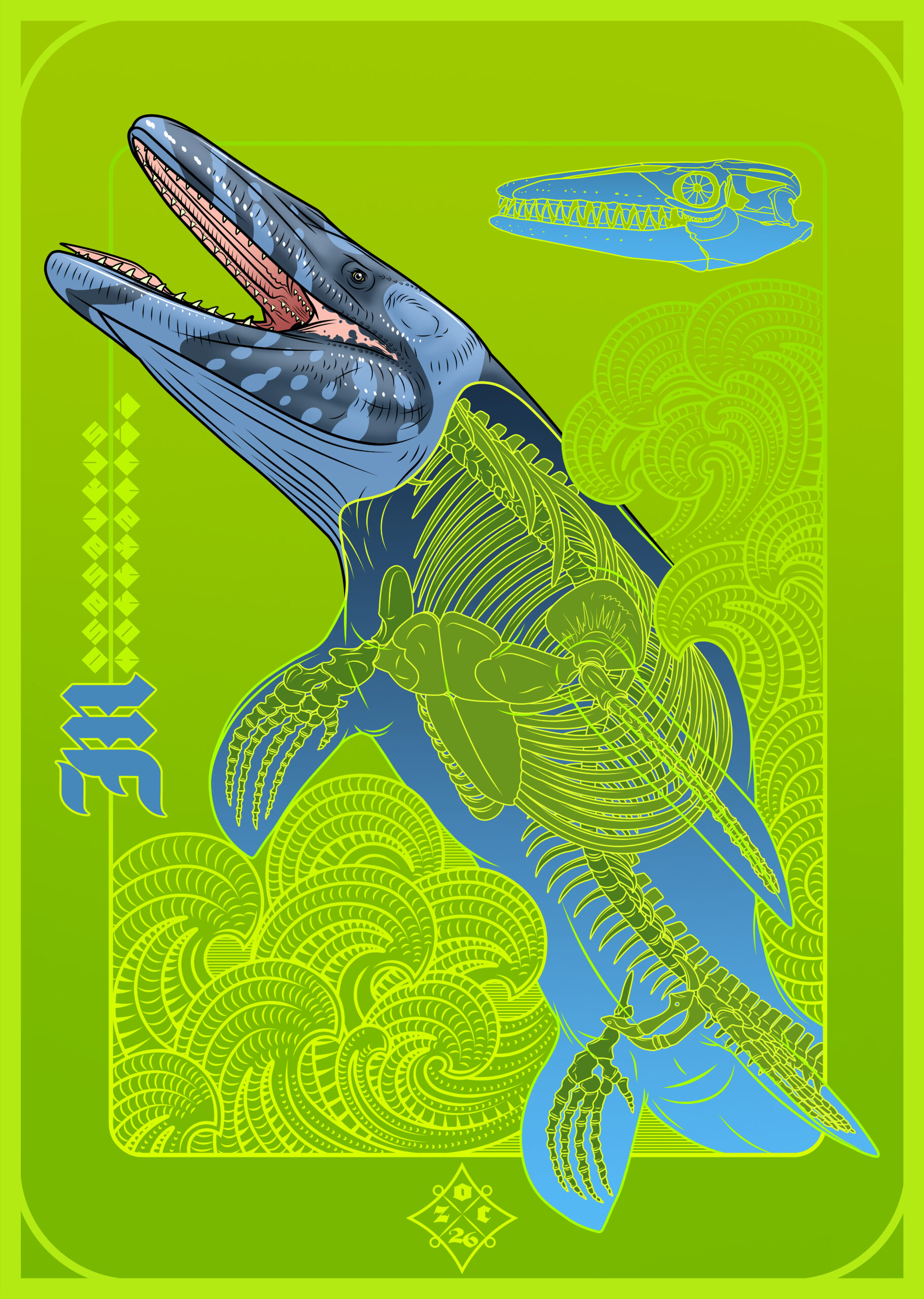
This specimen, consisting of the posterior portion of the skull of a large mosasaur from 70 million years ago, represents the first fossil of these marine reptiles ever found in Italy. Mosasaurs were animals related to modern monitor lizards and snakes, widespread across all oceans of the planet during the Late Cretaceous.
This fossil was discovered in 1886 in the bed of a stream near San Valentino in the Province of Reggio Emilia. Unfortunately, it is incomplete, as most of the bone surfaces are missing and some teeth are chipped.
It was first studied by Gustavo Uzielli in 1887, who mistakenly identified it as a large crocodile. In 1897, the palaeontologist Vittorio Simonelli assigned it to a new species,, naming it Capelliniosuchus mutinensis in honour of Professor Giovanni Capellini (a famous geologist and palaeontologist from Bologna). What misled the early scholars was the presence of two cavities located on the tip of the snout, visible in dorsal view, which were interpreted as nasal openings but later turned out to be tooth roots, exposed due to erosion of the specimen.
Only in 1990, nearly a century after its discovery Achille Sirotti correctly assigned the fossil to the genus Mosasaurus, accostandolo alla più grande specie nota, Mosasaurus hoffmannii. The most recent study, in 2014, finally led, through a more cautious attribution, to the designation Mosasaurus cf. hofmannii.
Theimportance of the specimen is not merely historical: mosasaur fossils in Italy are quite rare. Besides this specimen, only one other skull from the Verona area and a few isolated teeth found in the Belluno region are known. Additionally, another partial rostrum from Novafeltria (Rimini) was described in 2014 by Professor Federico Fanti and colleagues.
Classification and size comparison
Kingdom: Animalia
Phylum: Chordata
Class: Reptilia
Order: Squamata
Famiglia: †Mosasauridae
Genere: †Mosasaurus
Specie: †Mosasaurus cf. hoffmannii
Mantell, 1829
Modified from “Mosasaurus lemonnieri” from Macrophyseter, from Wikimedia Commons
(https://commons.wikimedia.org/wiki/File:Mosasaurus_lemonnieri.png),
licensed under CC BY‑SA 4.0 (https://creativecommons.org/licenses/by-sa/4.0/).
Geologic Time Scale
- ERA: Mesozoic
- PERIOD: Cretaceous
- EPOCH: Late Cretaceous
- ETÀ: Maastrichtiano (72,1-66 Ma)
Site of discovery
Rio Marangoni near San Valentino (RE)
Display location
Dipartimento di Scienze Chimiche e Geologiche dell'Università degli Studi di Modena e Reggio Emilia
Catalogue number:
IPUM 30200
Location of casts on display
Gallery
Paleoart corner
Bibliography:
- Fanti F., Cau A. & Negri A. (2014). A giant mosasaur (Reptilia, Squamata) with an unusually
twisted dentition from the Argille Scagliose Complex (late Campanian) of Northern Italy.
Cretaceous Research, 49: 91-104. - Palci A., Caldwell M.W., Papazzoni C.A. & Fornaciari E. (2014). Mosasaurine mosasaurs
(Squamata, Mosasauridae) from northern Italy. Journal of Vertebrate Paleontology, 34: 549-559. - Simonelli V. (1897). Intorno agli avanzi di Coccodrilliano scoperti a San Valentino (provincia di Reggio Emilia) nel 1886. Rendiconti della Reale Accademia dei Lincei, 5: 11-18.
- Sirotti A. (1990). Mosasaurus hoffmanni Mantell, 1828 (Reptilia) nelle “Argille scagliose” di S. Valentino (Reggio E.). Atti della Societa dei Naturalisti e Matematici di Modena, 120: 135-146.
- Uzielli G. (1887). Sopra un cranio di coccodrillo trovato nel Modenese. Bollettino della Società
Geologica Italiana, 5: 355-361.
Credits and acknowledgments
We sincerely thank Dr. Giovanni Serafini and Professor Cesare Andrea Papazzoni of the University of Modena and Reggio Emilia for sharing the multimedia material used on this page.
Reproduction, distribution, or any other use is prohibited without prior authorization from the rights holders.